
I didn’t set out on my journey into art education to make an impact on well-being and self-worth. I set out to share what I often call “art-joy”, that moment of ease and quiet satisfaction that often arrives when someone becomes absorbed in the creative process.
Over years of teaching people of all ages, and especially older adults and caregivers, I’ve watched smiles bloom and self-confidence grow when learners are given opportunities to explore visual art forms such as painting and printmaking. What may be viewed by some as simply an activity to fill the afternoon is often something much deeper. The opportunity to experiment with art materials can offer moments of calm, choice, and connection, steady ground, especially when circumstances feel uncertain or out of one’s control.
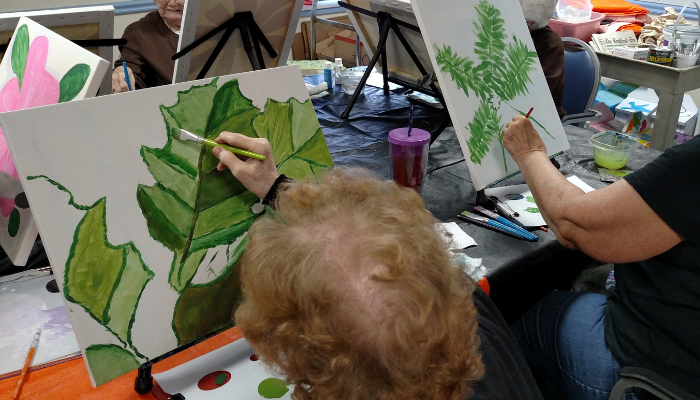
Macro view of nature -original paintings in process.
Familiar Rhythms in Practice
One recent example involves a dear friend of mine, Debbie. She loves adult coloring books. It’s something she returns to daily, a familiar rhythm.
After a major winter car accident, she found herself in the hospital, shaken and separated from the things that usually help her feel steady. One of the first things she mentioned to me in a text from her hospital bed was that her coloring supplies were still in the car, accompanied by a tearful emoji.
When her daughter arrived to visit and thoughtfully brought along a coloring book and markers, something shifted. Within minutes of Debbie’s daughter leaving, I received a photo of a sunrise mandala, partially colored. More photos arrived throughout the evening showing her progress.
What struck me wasn’t the coloring page itself, but what it represented: calm returning, familiarity re-established, and a small sense of steadiness in an unfamiliar place, all supported by the simple ability to choose between red and orange.
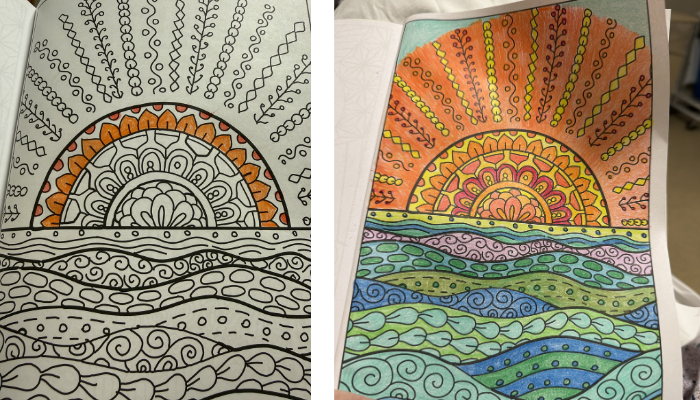
The calming progression of a partially colored and completed coloring page.
Choice in the Creative Process
The value of choice and its role in well-being and self-expression was made equally clear to me years ago in my role as a Teaching Artist and Artist-in-Healthcare. Anne, a resident who faithfully attended my twice-weekly art classes, paused after one session to thank me for being there. She shared that while she enjoyed the projects, what she truly appreciated most was the opportunity to make her own decisions.
Decision-making can be something we have a complicated relationship with, sometimes a burden, other times a joy. But for a care resident whose daily routines are often highly structured, having meaningful choices can be powerful. Even the freedom to turn a canvas vertically or horizontally, or to paint an orange sunset instead of a blue sky, opens the door to welcome possibilities.
Anne certainly took care with her work, but what she spoke about most was the process and the quiet satisfaction of creating something that was truly her own.
In my role as a teaching artist, I’ve worked with a wide range of care partners and have learned to design lessons with intention. Project steps are adapted to be achievable across varied cognitive abilities and physical challenges. Art materials are selected for accessibility, and themes are chosen to create meaningful points of connection for participants.
Over the past ten years, I’ve had the privilege of working alongside activity professionals in assisted living, skilled care, and memory care communities. I’ve seen firsthand the impact that thoughtfully designed, hands-on art lessons can have, building familiarity, confidence, and a growing sense of mastery.
I’ve also seen the limits imposed by funding. While many talented teaching artists are doing meaningful work, access to sustained, high-quality art experiences often becomes inconsistent once budgets tighten or programs are reduced. Too often, creativity becomes optional rather than essential.
Building Consistency in Senior Living
With several residencies on the horizon for late spring and summer, I continue to design lessons that intentionally include opportunities for choice, something that has been part of my approach from the beginning. Whether selecting colors, adjusting composition, or simply deciding where to begin, these small decisions often help participants feel more settled and more connected to the process.
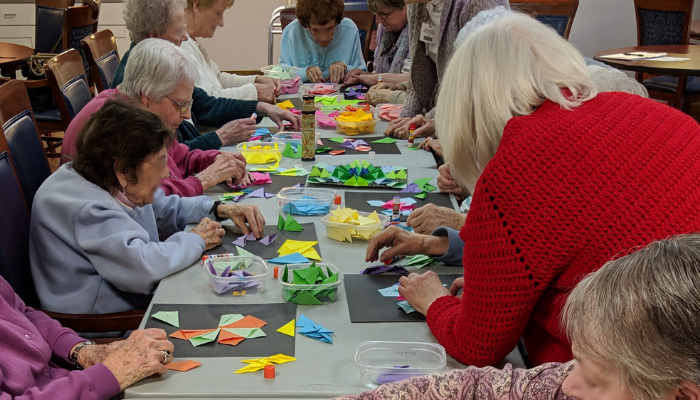
Regular sessions of creativity builds confidence and supports lifetime learners.
Over the years, I’ve also watched activity staff grow more confident working alongside residents, learning how to work with different art mediums in real time. In one senior living community I’ve partnered with for some time, interest has grown to the point that they now offer two art sessions for a single project. At the same time, as staff roles shift and new team members come on board, that hands-on learning for staff remains just as important. My hope is that by continuing to share practical tools and approaches in the room, creative experiences can remain consistent, familiar, and accessible for the people who benefit from them most.
In senior communities, consistency matters. An art project once a quarter is a welcome treat — but a weekly art session becomes something more. With time and repetition, it builds familiarity, confidence, and a quiet sense of mastery.
In recognition of National Caregivers Day (February 20)
To thank the activity professionals and care staff who support creative experiences every day, I’m sharing a small set of downloadable caregiver appreciation images.
You are welcome to print and share them within your community.
Download the caregiver appreciation images using the link below each graphic.


